

Just Say NO to Anesthesia-Free Dentals
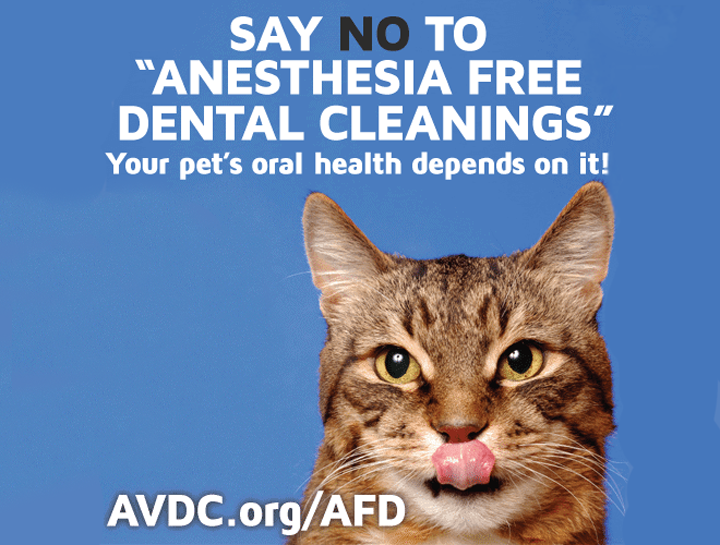
by Dr. Fern Slack, UCVC Medical Director and Feline-Exclusive Veterinarian
Are “awake” dental cleanings ok for cats? This is not a simple question, but it has a simple answer: NO. Let’s look at why this is.
Worried about anesthesia for your cat? Looking for a cheaper way to have your cat’s dental problems treated? Anesthesia-free dental services sound terrific, but a closer look tells us that they do little if any real good, while causing harm in several ways.
Dental cleaning is legally the practice of veterinary medicine. Only a licensed veterinarian, or a licensed veterinary technician under the supervision of a licensed veterinarian, may legally perform dental cleanings on animals, and for good reason: proper, effective dental cleaning requires a great deal of specialized training. It’s not just a matter of randomly scraping some stuff off a tooth. Many “anesthesia-free” dental services are offered by people who are not vets or techs, and often have no professional training. This alone can lead to many problems, but just clearing the bar of having a licensed and trained person doing such a cleaning does not make it okay.
Problems with anesthesia-free dental work
One big problem with “awake” dental work is the effect that the necessity for patient comfort has on the work that can be accomplished. Most tartar is firmly adhered to the tooth, and the most important part to remove is what’s up under the gumline. Cat dental problems often go unrecognized until the periodontal disease has progressed to the point where they have quite deep periodontal pockets, and there can be a lot of tartar in these deep pockets.
How would you feel?
If you’ve ever had a dental cleaning where an explorer was inserted into a periodontal pocket and hit a spot that made you jump out of your seat, consider that this is often EVERY tooth in a cat’s mouth. Getting a scaler deep into a periodontal pocket, and then exerting sufficient force to remove tartar, is likely to cause pain. Consequently, this is often not done at all with “awake” dental cleanings; usually, whatever cleaning takes place is cosmetic only and does not address the more important dental problems causing chronic oral pain and affecting overall health. It is imperative while wielding sharp instruments in a pet’s mouth that the operator takes no risk of causing pain. Causing pain might result in the pet moving its head quickly, which can result in tender gum tissue being lacerated by the cleaning tool.
Another significant concern for the operator is that he or she does not get bitten
It’s easy to see that a person performing an “awake” dental is highly incentivized to NOT work on the very areas that need it the most. The final effect may provide a guardian with a nice feeling of having accomplished something, but the effect is purely cosmetic. One big reason that anesthesia is necessary for safe feline dental work is the danger of aspirating chunks of tartar or bits and pieces of infected materials into the lungs. When under anesthesia, the placement of an endotracheal tube protects against this. Humans cooperate and breathe through their noses during their cleanings – cats cannot be expected to do any such thing.
Oral pathology is below the gumline
Perhaps the single most important reason that anesthesia is necessary for effective dental work in cats is that so very much feline oral pathology occurs below the gum line, where we cannot see it without exploring those painful periodontal pockets and taking X-rays. A complete oral examination (possible only under anesthesia) and full mouth X-rays (also requiring anesthesia) are necessary for a complete understanding of the extent of oral pathology in any cat. Without this, the removal of visible tartar is akin to “fixing” a rotting wooden wall by painting it — the problem may be hidden but will continue to worsen.
Polishing is necessary
Finally, there is the need to polish teeth after removing tartar. The act of tartar removal always leaves tiny scratches on tooth enamel. If these are not polished out, they provide a nidus for more rapid reaccumulation of tartar. Polishing is noisy – few dogs and virtually no cats will stand for it when awake, and it is virtually never done during “anesthesia-free” dental cleanings. Without polishing, awake tartar removal is harmful to the pet. Anesthesia-free dental cleanings often give pet guardians a false sense of having done something good. While less expensive in the short run, the outcome is often unrecognized and unaddressed dental disease, pain, and secondary systemic health problems, as well as much higher long-term costs to care for severe dental problems that have gone unidentified for many years.
The Uniquely Cats Way
At the Uniquely Cats Veterinary Center, we care about providing the very best dental care for our patients. Our dental procedures are performed in a state-of-the-art dental suite by highly trained veterinary professionals. Feline dental patients are placed under full anesthesia, with an endotracheal tube placed to prevent inhalation of cleaning debris. Anesthetic protocols are customized for the needs of each patient and monitored closely throughout the procedure. A complete oral evaluation is done for each patient, including full-mouth dental radiographs to detect problems not visible. The teeth are carefully cleaned and polished. Diseased teeth are ideally surgically extracted during the procedure, and the gums sutured for an easy recovery. Local anesthesia and general analgesic therapy are provided wherever needed. Recovery is rapid and patients go home the same day.
If you’d like to know more about feline dental care, give us a call at (303) 500-5158. We’re always happy to answer questions!
Learn more about what the American Veterinary Dental College has to say about anesthesia-free pet dentals.